
Seven citizens of Kosovo were arrested this week at the Croatia-Serbia border after officials discovered that they exceeded the allowed stay of 90 days in the Schengen Area within the rolling period of 180 persons according to reports in the Kosovo media Telegrafi and KlanKosova.
Border officers overseeing the outbound checks at the Batrovci-Bajakovo corridor stopped these travelers in the course of their routine checks. Officials noted that it was a clear violation of the visa-free travel rules in that all time spent in the Schengen states is considered cumulatively and the people had exceeded the allowed 90-day limit.
The border incident is not that isolated case. Earlier this year, on Sunday, June 22, seven Kosovo passengers were picked up at Memmingen Airport in Germany, according to Gazeta Online Reporteri.net.
The police reported that a married couple who had gone beyond the 90 days’ time limit, exceeded it by no less than two more weeks, and had been 15 days over due. A man 30 years old had overstayed his time limit by two days. A woman 50 years old had exceeded it by one day. The cases show that enforcement is going on at different places of entry and that even the brief periods of overstaying such as one or two days are detected and punished.
New Border System Assists In Detection
The incidents took place just in excess of a week since the European Union Entry-Exit System (EES) was put into effect on October 12 at the external borders of the EU. The electronic System makes it possible for officials quickly to check accumulations of stays by cross-reference with passport details and previous border crossings with the ease of detecting overstays very significantly assisted.
Early reports from the EES put into effect would indicate uneven uptake of the system across the member states with some border locations experiencing delays of up to three hours in processing the crossing of the borders as staff adjust to the new technology. Only three countries were prepared fully for the functioning of the system when it was put in place.
For a detailed snapshot of the initial rollout, including examples of 3-hour lines and which states were ready, see the week-one assessment of EES implementation in Europe’s border posts with key findings and queue reports.
Consequences for Overstays
Travelers exceeding the permitted stay of 90 days face heavy legal penalties which may be of consequence for their future traveling. A range of penalties can be applied from administrative fines to entry bans of many years duration, which can apply to entry into all Schengen countries. All such steps are at present routinely and systematically recorded in the Schengen Information System (SIS), which is a data base common for all Member States.
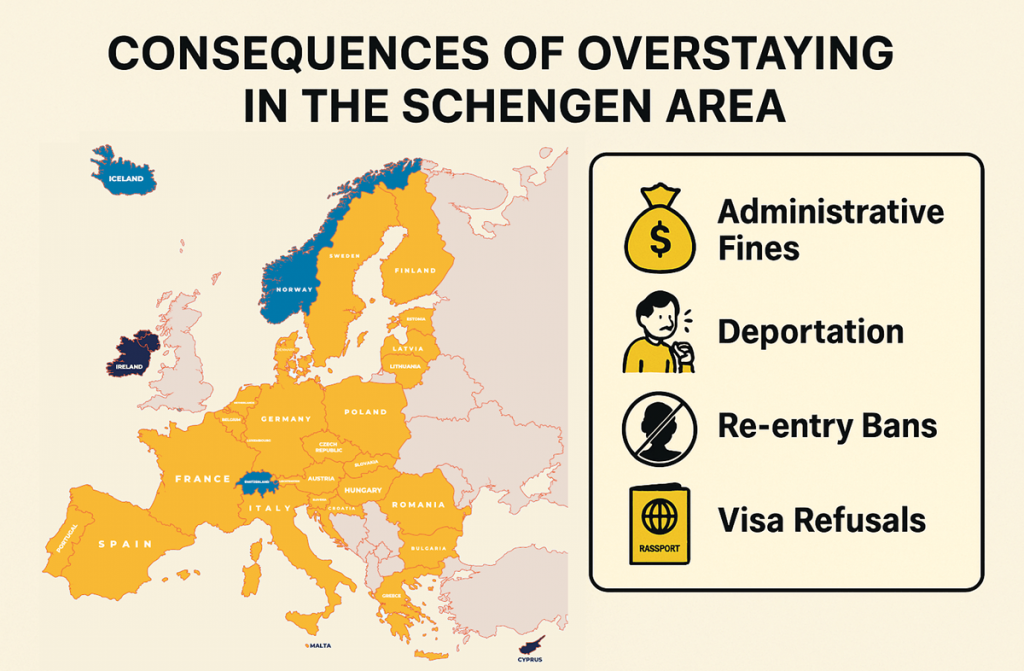
Our in-depth guide outlines the consequences of overstaying in Schengen, including fines, appeals, and how bans are issued so you know what to expect and how to respond.
Because border decisions are increasingly recorded and shared, it is also important to understand how SIS alerts can lead to entry denials across the Schengen area through a common information system used by member states.
Visa-Free Travel for Kosovo
Since January 2024 nationals of Kosovo have had visa free access to the Schengen Zone. This has immediately changed and immensely broadened the previous levels of mobility by travel to pensions, family visits and short business trips. But authorities at the outset, and travel experts have warned quite clearly that visa free admits close scrutiny.
Travellers on short stay must comply with laid down conditions of a maximum stay of 90 days, must if requested prove financial means to support themselves and furnish particulars of purpose of journey if asked.
The rolling nature of the 180 day calculation means that short trips can accumulate in unexpected ways.
Practical Suggestions for Travellers
Travel experts recommend various precautions to the attention of persons nearing their limit of stay as follows.
Carefully count your days. Use the official-style Schengen calculator for your number of days remaining, before booking any trips. The rolling nature of the window means that manual counting always produces errors.
Postpone unnecessary trips close to the 90 day deadline. Do not travel until earlier have dropped out of your 180 day window and allowed you to restore your pattern of movements.
Keep all your documentation. Hold on to your boarding passes, hotel receipts and entry-exit stamps, as proof of your history. Such history under the heading of the EES system is electronically recorded, but your own documentation will help disputes.
Leave yourself margin. Do not take the whole 90 days’ allowance if you are returning often to the Schengen Area. Leave yourself a margin for error or unusual happenings.
Be ready for the border. Have documentation indicating your intended time of departure from the Schengen area, proof of accommodation, return tickets and documentary proof of financial means.
The greater checking ability of the border police under the EES system means that border police are able to check immediately the full history of travel, which makes it well nigh in possible to arrive with a baggage of overstaying passengers unnoticed. With visa free travelling comes some heavier responsibilities to realize the rules attaching to short stay trips precisely.
For tool comparisons and tips on avoiding common counting errors, see our EES-era roundup of the best Schengen stay calculators with pros, cons, and accuracy notes.
Comments (0)