

Europe achieved something no empire, alliance or union had ever achieved before: it voluntarily removed its borders. The Schengen experiment is not just a convenient travel benefit for those fortunate enough to live in Europe, it is a political revolution that is hidden in plain view.
The Revolutionary Aspect of Schengen
The Schengen framework yields significant and tangible benefits for citizens, businesses and public authorities throughout the European territory. The benefits are considerable — and diverse. But to understand their true meaning we need to comprehend what Schengen means in the greater context of international law and European integration.
No region of the earth in human history has voluntarily dismantled internal borders to this extent. Sure the Romans had their empire, but that was enforced by conquest. The United States has free movement between the States, but they share each a single government. Schengen? It is 29 sovereign nations voluntarily trusting each to guard their own borders. That is unprecedented.
The Visible Benefits: Freedom of Movement
At the most evident level, travel becomes easy. Citizens, residents, holders of residence permits, … have all unrestricted access to the internal borders, and do not have to queue for hours at the border posts. Tourism is simplified. Travel for business is no different. It is possible to drive, in point of fact, from Portugal to Poland without the necessity of producing a passport. This is truly amazing when one comes to think of it.
But let us come now to the deeper question. The Court of Justice has always held the view that the free movement of persons is a fundamental right not merely a convenience. In Wijsenbeek (C-378/97) and Melki and Abdeli (C-188/10 and C-189/10), for example, it was laid down by the Court that any restriction on the freedom of movement must be necessary and proportionate. This is not a matter purely of policy, it amounts to quasi-constitutional law at the moment.
The psychological effects of all this? Inestimable. Citizens of border regions acquire a new formula by means of which sociologists speak of transnational habitus. In other words, they become thinkers and actors non-nationally but European. The children of Strasbourg have friends in Kehl. The workers at Lille have their lunch in Belgium. This was not known in the days of our fathers, now it is normal.
Economic Dimensions: Beyond the Obvious
Then there’s economic growth. The removal of border controls has enhanced trade flows significantly. Tourism too. Goods and services circulate more efficiently when trucks don’t have to stop every few hundred kilometers for document checks. A Spanish company can deliver to Germany as easily as they deliver domestically. Well, almost as easily.
The European Union’s economy reached $19.99 trillion (nominal) in 2025, representing approximately one-sixth of the global economy. A 2016 study by the Centre for Economic Policy Research found that complete Schengen collapse would reduce EU GDP by 0.31%. Applied to today’s economy, that translates to roughly $62 billion annually – a staggering cost that underscores just how economically vital the border-free zone has become. And that’s conservative. It doesn’t capture the dynamic effects: companies that exist only because of Schengen, supply chains that became viable, innovations that emerged from cross-border collaboration.
Think of Zalando, the German e-commerce giant. They can deliver to Belgium and Germany within 24 hours, just as if they were domestic goods. Their entire business depends upon logistics without borders – Pre-Schengen? Impossible.
Smaller businesses probably benefit the most, proportionately. A craftsperson in Slovenia is now able to sell at markets throughout Austria, Italy and Croatia without the previous bureaucratic nightmare. Food trucks tail festivals across borders. Plumbers in border areas can service customers in 2-3 countries. These are not multi-national corporations staffed by teams of lawyers. These are regular folks whose whole living has been transformed.
The Labour Market Revolution
The employment side is substantial. EU Citizens can more easily work across borders today. Have a job offer in Amsterdam but live in Brussels? Not a problem, just commute. Seasonal workers can follow their crops from Spain to Germany to Poland. And if they have a currently valid residence in some other country, it is easier to move about in the balance. The flexibility of labor marketing has been increased tremendously.
But that which the statistics do not show is that labor market organization is not limited to figures. It consists largely in supplying the different needs and abilities alike over a whole continent. The German engineering firm which gets the right man in Prague. The Italian restaurant in Stockholm which can get actual Italian cooks. The French hospital which can secure Spanish nurses during times of shortage.
Professor Alberto Alemanno of H.E.C. at Paris calls this “the invisible hand of Schengen,” the economic forces in operation over a continental area, distributing human resources where they will be most efficient. The classical economists would weep with joy.
Cultural and Social Integration
Cultural exchange – this is not so easily measured but it exists. Greater mobility means that people actually meet their European neighbours. Students go through Erasmus programmes without worried about any border formalities. Families scattered over three or four countries can keep in touch. It creates mutual understanding and, in some sense or other, a kind of shared European identity. How much, of course, is debatable.
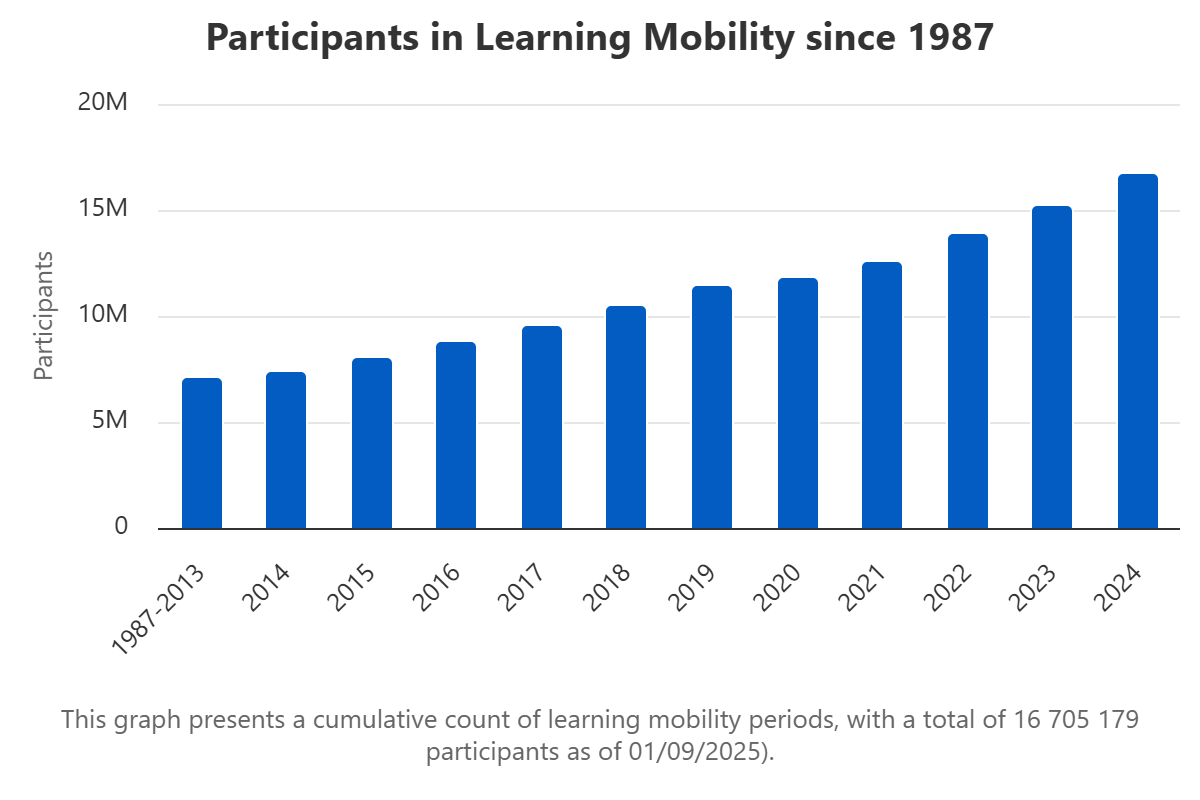
The Erasmus generation – over 16.7 million participants since 1987 according to the European Commission’s latest data – couldn’t have happened without Schengen. These aren’t tourists; they’re living, studying, falling in love across borders. The famous “one million Erasmus babies” figure from the 2014 EU Impact Study captures something profound: a generation of genuinely European citizens born from cross-border relationships.
Jurgen Habermas, the German philosopher, argues that Schengen enables what he calls “constitutional patriotism” – loyalty to shared values rather than ethnic identity. You see it in the protests when governments threaten to reintroduce borders. Young Europeans don’t just tolerate free movement; they consider it a birthright.
Emergency Response and Crisis Management
There’s also emergency response which people don’t think about until they need it. No internal border checks means ambulances can rush patients to the nearest hospital, even if it’s across a border. Firefighters can respond to forest fires without paperwork delays. During floods or other disasters, help arrives faster. Coordination is just easier when you’re not dealing with border bureaucracy.
The 2021 floods in Germany and Belgium proved this. Belgian rescue teams were operating near Aachen within hours. Dutch helicopters evacuated German citizens. Luxembourg hospitals treated patients from all three neighbors. The EU Civil Protection Mechanism enabled seamless cross-border hospital cooperation through the Euregio-Meuse-Rhine framework. No paperwork, no delays, just help arriving when needed. Try explaining that to someone from the 1980s.
The COVID Test: What We Almost Lost
Want proof of Schengen’s value? Look at what happened during COVID-19. When EU reintroduced temporary internal border controls in March 2020, the costs were staggering. Supply chains broke down. Commuters couldn’t get to work. Tourism collapsed entirely in some regions. Fresh produce rotted in trucks stuck at borders that hadn’t existed for decades.
The European Commission documented massive disruptions. During the worst period, logistics companies reported delays of 40+ hours at some borders. Pharmaceutical companies couldn’t get medicines to hospitals efficiently. Even essential workers – doctors, nurses – struggled to cross borders to their workplaces.
But here’s what really matters: the political reaction. The reintroduction of borders wasn’t coordinated. It was panic – pure national reflex. Italy closed first, then Austria, then everyone else in a cascade of unilateral decisions. The Commission was helpless. Years of integration unraveled in a few hours.
Yet the system survived. Why? Because the costs of closure were immediately obvious. Industries screamed. Regions rebelled. Citizens demanded their freedoms back. By May 2020, governments were desperately seeking ways to reopen. The “temporary” measures that skeptics predicted would become permanent? They couldn’t last a few months.
The Intangible Benefits
But it is not just economic. There is something which is fundamentally different about living in a borderless Europe. Weekend trips to neighbouring countries become spontaneous. “Let’s go for a drive to that restaurant in Belgium” is a normal Saturday plan if you live in Maastricht. Children grow up thinking that it is normal to have friends from four different countries. That psychological change from “foreign” to “next door” is probably Schengen’s greatest impact.
As a friend of mine in Germany said: “Schengen did not only abolish the frontiers; it took them away from our minds”. The mental maps of young Europeans do not have the thick black lines our parents drew. They see a continuum, not a patchwork.
Measuring the Unmeasurable
Of course, measuring some of these benefits accurately is difficult. How do you quantify “cultural exchange”? What is the monetary worth of being able to visit Grandma in another country without border hassle? The European Commission does it with their impact studies and economic models. But there are some benefits that cannot touch a spreadsheet.
The methodological difficulties are very real. Traditional economic models assume “closed systems”. Schengen creates an open one. How do you put a figure on options not taken up? The job not taken because it could have been taken? The business not started because it could have been started? The threat that does not materialise because the criminals know that the police cooperate?
The Security Dividend
And then there are the side effects that are not foreseen. Cross-border hospital cooperation means that specialised treatments are to be had more simply. Police can pursue criminals across borders more effectively (although of course that is a double-edged sword depending on whether you are on the perspective of the policemen or the criminals.) Even things like cross-border public transport have become viable – trains and buses that simply would not have been economically viable with border controls.
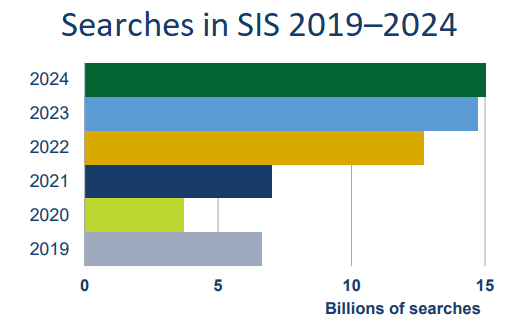
In 2024, authorities connected to the system recorded 15,044,676,229 access instances. That’s over fifteen billion searches. Not million – billion.
Want some context? Back in 2021, member states ran about 7 billion searches through the system. By 2022, that jumped to 12.7 billion (an 81% increase from the previous year). And now we’re at fifteen billion. Every few seconds – literally every few seconds – somewhere in Europe, someone’s checking if a person’s wanted, if a vehicle’s stolen, or if documents are legitimate.
Ireland shows exactly why this matters. Despite not being in the border-free zone, they joined SIS II in early 2021 to strengthen their security. In just nine months, Irish police arrested 162 people flagged in the system – individuals wanted for everything from sexual assault to drug trafficking to burglary across Europe. These weren’t local criminals; they were people who’d committed crimes elsewhere in Europe and thought they could disappear in Dublin or Cork. Before SIS II? They probably could have. Now? The Garda can instantly check if that person at a routine traffic stop is wanted in Rome or Warsaw.
It’s become the backbone of European security cooperation, though most people have no idea it even exists. Ireland’s not even fully in Schengen, yet they’re catching over 18 criminals a month through the system. Imagine the impact across all 29 countries.
In March 2023, a renewed version of the system (referred to as “SIS-Recast”) became operational, replacing SIS II and introducing enhanced capabilities for law enforcement and border management. It’s the most consulted database in Europe. Critics focus on surveillance concerns (valid ones), but the operational benefits are undeniable. Ireland’s Garda notes the system enables real-time alerts across the entire Schengen zone for wanted persons, missing children, and stolen property.
Alphanumeric searches performed in 2024, breakdown per Member State/JHA Agency
| Member State / Entity | Alphanumeric searches – manual processes | Alphanumeric searches – automated processes | Total alphanumeric searches |
|---|---|---|---|
| AT | 233,617,057 | ||
| BE | 53,389,294 | 2,935,980,638 | 2,989,369,932 |
| BG | 2,555,424 | 197,469,798 | 200,025,222 |
| HR | 365,305,261 | 237,484,043 | 602,789,304 |
| CY | 44,061,894 | 0 | 44,061,894 |
| CZ | 92,222,667 | 136,835,952 | 229,058,619 |
| DK | 47,558,269 | ||
| EE | 70,976,375 | ||
| FI | 30,242,417 | 39,413,027 | 69,655,444 |
| FR | 334,913,195 | 1,071,581,357 | 1,406,494,552 |
| DE | 765,100,274 | ||
| EL | 102,373,509 | 20,760,505 | 123,134,014 |
| HU | 89,573 | 133,539,059 | 133,628,632 |
| IS | 39,557 | 55,501,545 | 55,541,102 |
| IE | 15,475,999 | 4,805,533 | 20,281,532 |
| IT | 367,292,649 | 343,460,689 | 710,753,338 |
| LV | 46,797,926 | ||
| LI | 247,249 | 551,457 | 798,706 |
| LT | 34,015,064 | 0 | 34,015,064 |
| LU | 8,817,179 | 13,087,313 | 21,904,492 |
| MT | 14,471,112 | 98,566,746 | 113,037,858 |
| NL | 260,953,234 | 3,919,309,565 | 4,180,262,799 |
| NO | 68,137,072 | 7,812,832 | 75,949,904 |
| PL | 571,005,765 | ||
| PT | 116,701,441 | 0 | 116,701,441 |
| RO | 445,054,394 | ||
| SK | 35,821,715 | 20,547,811 | 56,369,526 |
| SI | 53,593,561 | 0 | 53,593,561 |
| ES | 571,139,225 | 698,059,052 | 1,269,198,277 |
| SE | 75,683,941 | ||
| CH | 251,332,378 | ||
| Total MS | 3,312,904,192 | 9,934,766,922 | 15,013,751,592 |
| Eurojust | |||
| Europol | 476,883 | ||
| Frontex | 679 | ||
| TOTAL | 3,313,381,754 | 9,934,766,922 | 15,014,229,154 |
Constitutional and Legal Innovations
What is not often said is that Schengen led to legal innovation. The principle of mutual recognition, now part and parcel of EU law, was born in the need created by Schengen. If a visa valid in Portugal is valid in Poland, why not a law degree valid in Portugal? Or a product standard valid there? Schengen became the laboratory for a more general integration.
The European Arrest Warrant, the European Investigation Order, the European Public Prosecutor’s Office, these are all based on the foundation laid down by Schengen. The emergence of a legal space in Europe is under way. Not through great constitutional moments, but through practical cooperation. In practice, Schengen is building from below the basis for European federalism.
The Geopolitical Dimension
Schengen also embodies soft power. When Ukrainian demonstrators waved EU flags in 2014, they were not dreaming of agricultural subsidies. They aspired to have what Schengen connotes: inclusion in a space of freedom and prosperity. The agreement has become a catchword for what Europe is able to achieve when it transcends nationalism.
Brexit negotiations revealed the strategic value of Schengen. The UK’s resolution to end free movement of persons entailed cost which had not been foreseen. The border of Northern Ireland became an unsolvable problem, proximately for the reason that it had been forgotten what borders mean. Absent Schengen defined the negotiations, as its presence in turn defines the continent.
Challenges and Adaptations
The system is far from perfect, of course. The migration crisis in 2015 revealed weaknesses of external border management. The Covid pandemic demonstrated how quickly national reflexes return. Terrorism, organized crime, hybrid threats from hostile states – all these challenge the robustness of Schengen.
But here is the main insight: Schengen adapts all the time. After 2015, the European Border and Coast Guard Agency was established with real operational capacity. After Covid, protocols are being created regarding health aspects in order to preserve the free movement of people during the pandemic. After Russia’s aggression there is now a strengthening of external borders, but the internal ones remain open.
Such adaptability is not a weakness, but an evolutionary strength. Rigid systems break down. Flexible ones survive. Schengen is flexible but does not crack, because it serves really existing human needs, and not abstract principles.
The Democratic Paradox
There’s a paradox here worth exploring. Schengen is profoundly democratizing – it gives ordinary citizens freedoms previously reserved for elites. Yet it emerged from intergovernmental negotiations, not popular movements. The people didn’t demand Schengen; they discovered they loved it after it existed.
This challenges our assumptions about European integration. Maybe citizens don’t need to understand every technical detail. Maybe they just need to experience the benefits.
Schengen suggests that Europe is built not through referendums but through creating realities people can’t imagine living without.
Future Trajectories
Where does Schengen go from here? The answer is obvious: east. The western Balkans are knocking. Ukraine has submitted its application for EU membership. Geographically and economically, this seems destined to happen. Mother nature’s boundaries for Europe are: the Atlantic, that Mediterranean, and, whatever controversy flows from it, something in the east of Europe.
But the deeper question is: can the Schengen model be replicated? ASEAN is looking at this. The African Union has similar ambitions. There have been attempts to do this within Mercosur. None have succeeded like Schengen. The reason for this is that Schengen required, not merely the removing of borders and boundaries, but rather the building of a trust, a sharing of sovereignty, and an acceptance that your neighbour’s problem was your problem as well.
That is the real revolution. Not the lack of border posts, but the existence of solidarity. When Portugal had a financial crisis, Schengen continued. When Greece was on the verge of leaving Euro, again Schengen survived. The arrangement has survived through recessions, through periods of terrorism, through the migration crises and through pandemics. It has survived longer than many expected it would.
Conclusion: The Irreversible Experiment
Even the critics of the EU almost universally accept that Schengen, whatever its flaws, has made life easier for millions of Europeans. And when, in 2020, everybody saw what border controls meant, they have developed a new appreciation for what was almost lost.
But “appreciation” falls short. Schengen has become constitutive of European identity. You can imagine the EU without the euro (some countries do not participate in it). You can imagine it without the Commission (though it would be different). But can you imagine it with hard borders between France and Germany? Between Austria and Italy? The answer is obvious.
A threshold has been crossed. There are some changes which can never be undone, not because it is legally impossible but psychologically impossible to undo. Schengen is one of those changes. It has made a generation who takes Free Movement of Persons as a right, not as a privilege, as a principle not as a policy, as being instead of as an experiment.
As Jean Monnet wrote in his 1976 memoirs (Mémoires): “Europe will be forged in crises, and will be the sum of the solutions adopted for those crises.” Schengen has been tested by every crisis imaginable. It’s still here. That’s not just policy success; it’s proof that some ideas, once realized, become undeniable.
The American legal scholar Joseph Weiler once asked: “What is Europe’s constitutional moment?” Perhaps it wasn’t Maastricht or Lisbon. Perhaps it was that morning on March 26, 1995, when the first car drove from Germany to France without stopping. No fanfare, no ceremony, just ordinary people discovering they could go where they pleased.
That is the genius of Schengen. It has made remarkable normal. And when it has once become normal, it is indispensable. Try taking it away and see what cares the European has.
Of course, it came about through not easily. And it does not now. In spite of popular delusion to the contrary, it is by no means an easy matter to land into this Eden of borderless life.
Myth: Any European country may get into Schengen at will.
Fact: Access to it is through strict compliance with the rules of the EU as to management of border, issue of visas, data collection and sharing and police co-operation. The states are subjected to a scrutinising close examination and must be agreed upon unanimously by existing members before internal frontier checks may be set free. The whole matter normally takes five to ten years at a minimum, as witness the eighteen years’ campaign of Bulgaria and Rumania.
The complexity of access to Schengen is that luxuriant life is made possible. Every new member has shown that he can be trusted to protect the safety of all concerned. Mutual trust, established slowly and thoroughly tested, is the only reason that it is possible for millions to cross frontiers, not showing a passport.
It’s not just free movement; it’s earned freedom.
- This article was written by Besart Bajrami, founder of SchengenVisaInfo.com. Since establishing the platform in 2013, he has been providing reliable information on Schengen visas, travel policies, and the latest EU visa regulations.
Comments (0)